

We have all been taught the same basic rule when it comes to phishing emails:
Never trust an email simply because it looks legitimate.
Check the sender. Look at the domain. Watch for spelling mistakes. Be suspicious of urgent requests. Check whether the email passed SPF, DKIM and DMARC. And, most importantly, never enter sensitive information simply because an email tells you to.
But what happens when almost all of those checks appear to pass?
That is exactly what makes the latest phishing campaign targeting Trezor users so concerning.
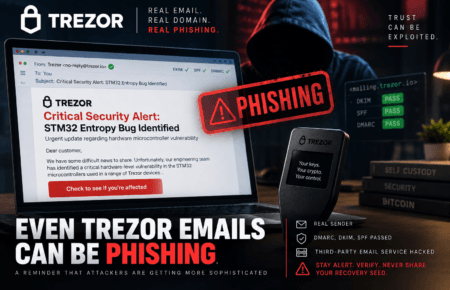
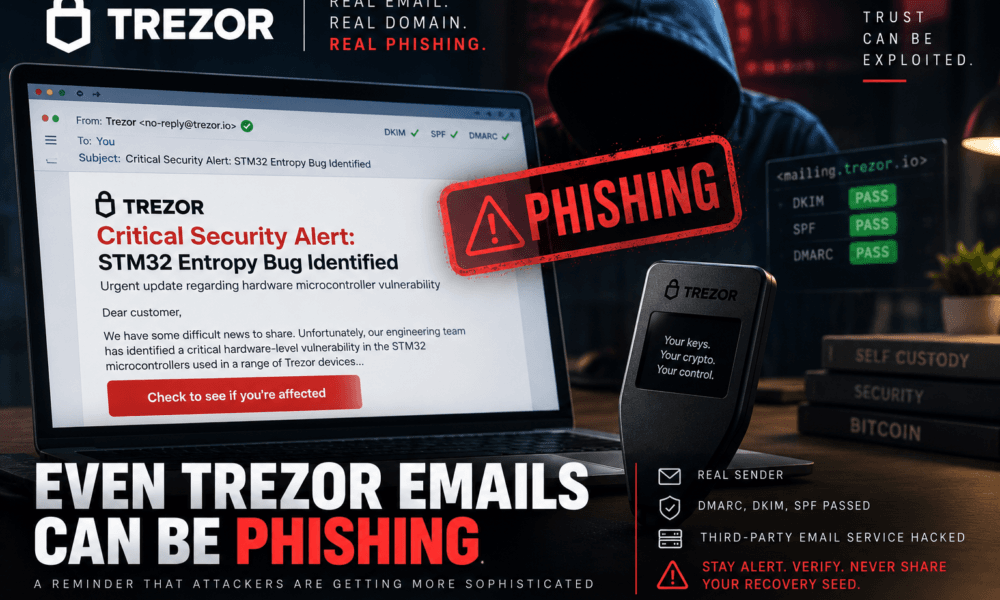
A highly convincing email claiming to be from Trezor was sent to users warning of a supposedly critical hardware vulnerability affecting Trezor devices. The message looked professional, used genuine Trezor branding and, most importantly, appeared to come from Trezor’s legitimate email infrastructure.
It was a scam.
But this was not a simple case of someone registering a fake domain like trezor-security-alert.com and pretending to be Trezor.
Trezor has now confirmed that an unauthorized email was sent to its newsletter database through a third-party email service provider used by the company.
In other words, the attackers appear to have compromised part of the trusted infrastructure Trezor uses to communicate with its customers.
And that makes this incident an important warning for the entire cryptocurrency industry.
Table Of Content
- The email looked terrifyingly legitimate
- This time, checking the sender was not enough
- SPF and DKIM cannot tell you whether an email is truthful
- The phishing message used a very clever story
- The real Trezor email tells a very different story
- The recovery seed remains the ultimate target
- The fake “entropy checker” was particularly dangerous
- There was a grain of technical truth behind the story
- This is why the attack is different
- What you should do if you received the email
- What if you already clicked the link?
- The bigger lesson for Bitcoin users
- The new golden rule: verify independently
- A wake-up call for the entire crypto industry
The email looked terrifyingly legitimate
The phishing email carried the subject:
“Critical Security Alert: STM32 Entropy Vulnerability”
For anyone familiar with hardware wallets, the subject alone would be alarming.
The message claimed that Trezor engineers had discovered a critical hardware-level vulnerability in the STM32 microcontrollers used in Trezor devices.
According to the fraudulent message, approximately one in four devices could have been affected, with some supposedly generating recovery seeds with as little as 40 bits of entropy.
The consequences described were severe:
- Insufficient randomness during recovery-phrase generation
- Potential exposure of wallet seeds to brute-force attacks
- Vulnerable wallets supposedly containing dramatically reduced entropy
- An urgent need to check whether a device was affected
The email then directed recipients to an online “entropy check” tool.
For a Trezor owner, this was precisely the sort of message that could cause immediate panic.
If the claims had been real, the implications would have been enormous.
Trezor is one of the most established hardware-wallet manufacturers in the cryptocurrency industry. A genuine vulnerability allowing attackers to predict wallet seeds could potentially put an enormous number of Bitcoin and cryptocurrency holdings at risk.
There was just one problem: The vulnerability did not exist
This time, checking the sender was not enough
Normally, one of the first things a security-conscious user does is inspect the sender’s address.
If the email supposedly comes from Trezor but is actually sent from an unrelated domain, the scam becomes much easier to identify.
But in this case, users reported seeing legitimate-looking Trezor infrastructure in the email headers.
The message was associated with mailing.trezor.io, and recipients reported that normal authentication checks including SPF, DKIM and DMARC passed.
That is precisely what made the attack so dangerous.
The email was not simply pretending to originate from an unrelated server.
According to Trezor, the attackers had abused a third-party email service provider used by Trezor to send the unauthorized messages. Trezor subsequently confirmed that the email was a phishing attempt and said it had taken action against the affected infrastructure.
This is an important distinction. The attackers did not necessarily need to defeat SPF or DKIM. They could instead use an already-authorized system.
SPF and DKIM cannot tell you whether an email is truthful
This incident highlights a common misunderstanding about email security.
SPF, DKIM and DMARC are extremely useful technologies, but they do not answer the question:
“Did Trezor actually approve this message?”
They primarily establish whether the email was authorized to use particular sending infrastructure and whether cryptographic authentication checks pass.
If an attacker compromises an account or service that is legitimately authorized to send mail for a company, the situation changes completely.
The attacker may be able to send a malicious message through the legitimate system.
From an email authentication perspective, everything can look perfectly normal.
It is similar to someone stealing an employee’s company badge:
The badge is real. The building recognizes the badge. The person carrying it is still unauthorized.
That is effectively the problem here.
The phishing message used a very clever story
The attackers also understood their audience.
Instead of offering a fake Bitcoin giveaway or claiming that users had won some imaginary reward, they created a security emergency.
The message warned about weak entropy.
It mentioned STM32 microcontrollers.
It discussed recovery phrases.
It talked about brute-force attacks.
It even included technical terminology such as BIP-39 and SLIP-39.
Most importantly, it used the fear that every hardware-wallet owner has:
What if someone can get my Bitcoin?
The email also contained legitimate-sounding security advice.
It told recipients:
“NEVER enter your recovery phrase on a website or share it with anyone.”
That statement is absolutely correct.
But then the email immediately encouraged users to visit a website to perform a supposed security check.
This is classic social engineering.
The attacker establishes credibility by giving good advice and then uses that credibility to get the victim to perform the dangerous action.
The real Trezor email tells a very different story
Trezor subsequently sent an official warning to users.
The company stated that the incident involved:
“an unauthorized email sent to our newsletter database from a third-party email service provider we use, impersonating Trezor.”
Trezor told users not to click links or provide personal information if they received the fraudulent message.
More importantly, Trezor provided a very clear instruction for anyone who may have interacted with the phishing campaign:
If you entered your wallet backup, move your funds to a new wallet immediately.
But there is also an important piece of reassurance.
Trezor states that:
If you have not entered your wallet backup anywhere other than on your Trezor device, your assets remain secure.
That is an important distinction.
Simply receiving the email does not compromise a Trezor wallet.
And receiving the message does not mean that the attacker’s claim about weak STM32 entropy is real.
The danger comes from interacting with the phishing campaign and, most critically, exposing the wallet backup.
The recovery seed remains the ultimate target
The reason these attacks are so effective is that cryptocurrency has one particularly valuable secret: Your recovery seed.
Whoever controls the recovery seed can generally control the assets associated with it.
That means attackers don’t necessarily need to compromise the hardware wallet itself. They can simply convince the owner to give them the information required to recreate the wallet.
This is why phishing is such a powerful attack against cryptocurrency users.
-> The attacker doesn’t have to break the cryptography.
-> They don’t have to defeat the hardware security.
-> They don’t have to brute-force Bitcoin’s private keys.
-> They just have to convince the owner to hand over the keys.
The fake “entropy checker” was particularly dangerous
The fraudulent email instructed users to click a button to determine whether their wallet was affected.
This is exactly the kind of scenario where a victim may believe they are following good security practices.
After all, they aren’t being asked to send Bitcoin to someone.
They’re supposedly checking their hardware wallet for a critical vulnerability.
That’s precisely why the attack works.
According to reports from users who investigated the phishing page, the campaign went further than simply collecting information through a website. One user reported that the downloaded HTML file contained JavaScript designed to exfiltrate the recovery seed to a Telegram bot.
That makes the instruction to never enter a recovery seed into a website even more important.
There was a grain of technical truth behind the story
The fake Trezor vulnerability was not completely invented from thin air.
The attackers appear to have constructed a convincing story around a real type of cryptocurrency security problem: weak entropy.
Entropy is the randomness used when generating cryptographic keys.
Trezor itself explains that entropy is fundamental to wallet security and that weak entropy can make private keys predictable. Trezor devices use multiple sources of entropy when generating a wallet, rather than relying on a single source.
This makes the fake email sound technically credible.
The attackers essentially took a real security concept and constructed a fictional Trezor emergency around it.
That is a common characteristic of sophisticated phishing.
The information doesn’t necessarily have to be completely fabricated.
It simply has to be convincing enough to make the victim take the desired action.
This is why the attack is different
There have been countless fake Trezor emails.
There have been fake websites.
Fake support agents.
Fake firmware updates.
Fake wallet applications.
None of that is particularly surprising anymore.
What makes this incident different is the trusted delivery channel.
The email wasn’t simply an obvious spoof.
Trezor itself has confirmed that an unauthorized message was sent through a third-party email service provider used by the company.
That means the usual advice of:
“Just check that the email really came from Trezor.”
is no longer sufficient.
The better rule is:
Never trust the action requested by an email. Verify the action independently.
What you should do if you received the email
If you received the “Critical Security Alert: STM32 Entropy Vulnerability” email, do not click any links contained in it.
Do not enter your recovery seed.
Do not enter your wallet backup.
Do not provide an extended public key or other wallet information to an unknown website.
Instead, open your browser independently and navigate to Trezor’s official website using a bookmark or an address you already trust.
The same principle applies to exchanges, banks, password managers and other security-critical services.
If an email tells you there is an emergency, don’t use the email itself to solve the emergency.
Go directly to the company’s official website or application.
What if you already clicked the link?
Clicking a phishing link is not automatically the same as losing your Bitcoin.
The important question is what happened afterwards.
If you clicked the link but never entered your recovery seed, wallet backup or other sensitive information, the situation is very different from someone who entered their recovery phrase into the attacker’s website.
Trezor’s official warning specifically says that users who have not entered their wallet backup anywhere other than on their Trezor device remain secure.
If, however, you entered your recovery seed into the phishing website, you should assume that seed is compromised.
The appropriate response is to create a new wallet using a trusted device and move the funds to addresses controlled by the new wallet.
Do not continue using a wallet whose recovery seed has been exposed.
The bigger lesson for Bitcoin users
This incident demonstrates something that every cryptocurrency user should understand.
Authentication is not the same as authenticity.
An email can pass SPF.
It can pass DKIM.
It can pass DMARC.
It can come from a legitimate company domain.
It can look professionally designed.
It can contain the company’s real logos.
It can even be delivered through infrastructure that the company genuinely uses.
And it can still be malicious.
That doesn’t mean email authentication is useless.
Quite the opposite. SPF, DKIM and DMARC are important parts of modern email security.
But they cannot protect users from every compromised account, compromised provider or malicious insider.
The final line of defense is still the user.
The new golden rule: verify independently
The old security advice was:
Check the sender.
The new advice needs to be:
Check the sender — and then independently verify the request.
If Trezor emails you about a critical vulnerability, don’t click the link in the email.
Open the Trezor website yourself.
If your exchange says your account is frozen, don’t use the link in the email.
Open the exchange application yourself.
If your bank says you need to verify your identity, don’t follow the email link.
Open your banking app yourself.
And if anyone asks for your recovery seed?
Stop.
There is almost no legitimate reason to give it to anyone.
Your recovery seed should remain offline and under your control.
A wake-up call for the entire crypto industry
The Trezor incident is more than another phishing campaign.
It is a demonstration of how the traditional indicators of a fake email can fail when attackers compromise trusted infrastructure.
For years, crypto users have been told to look for suspicious domains, bad spelling, fake logos and failed authentication.
Those remain useful warning signs.
But sophisticated attackers are increasingly targeting the infrastructure behind trusted brands rather than simply imitating the brands themselves.
And that creates a much more dangerous form of phishing.
The email doesn’t have to look real.
It can actually be delivered through a real system.
That is why the most important security principle remains the simplest one:
Never let an email decide what you do with your Bitcoin.
If a message tells you that your wallet is in danger, verify the warning independently.
And if anyone asks for your recovery seed online, no matter how convincing the message looks, do not give it to them.
Your seed belongs to you.
Not Trezor.
Not an exchange.
Not customer support.
And certainly not an email.

René
Editor