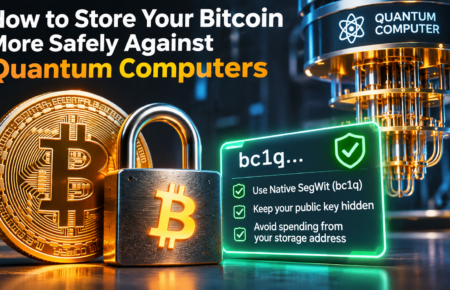

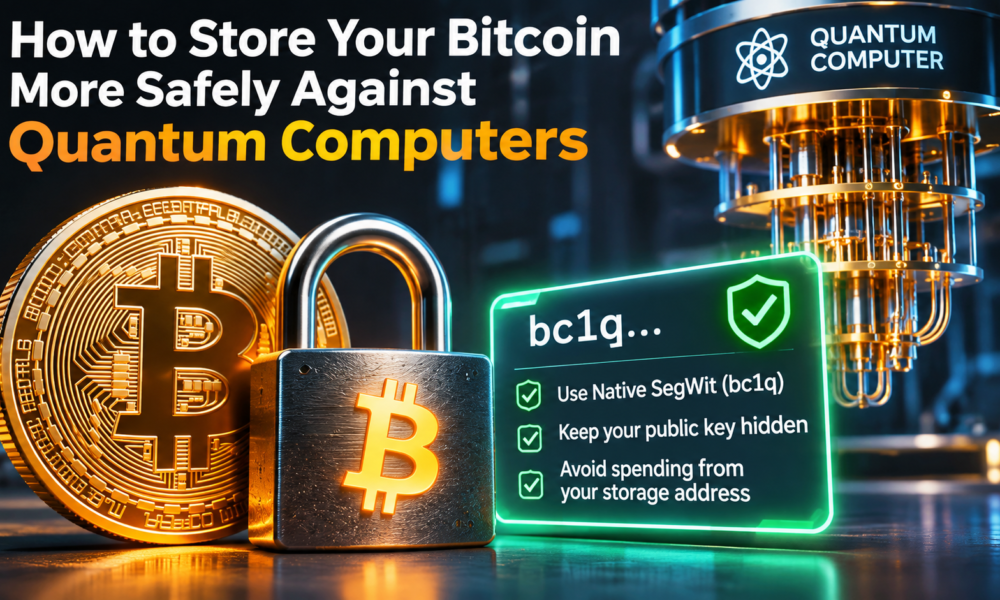
Could quantum computers or AI eventually steal your Bitcoin? While a sufficiently powerful quantum computer capable of breaking Bitcoin’s cryptography does not yet exist, there are steps you can take today to reduce your exposure. One of the simplest is to understand how Bitcoin addresses reveal public keys.
Table Of Content
- The Quantum Threat to Bitcoin
- What about AI?
- Not All Bitcoin Addresses Reveal the Same Information
- Why Spending Bitcoin Reveals Your Public Key
- A Simple Strategy: Use a Dedicated Bitcoin Storage Address
- What About Your Bitcoin Wallet’s Change Address?
- Important: The Public Key Can Also Be Exposed Outside the Blockchain
- Is Native SegWit Completely Quantum-Safe?
- Practical Recommendations for Long-Term Bitcoin Storage
- Conclusion: Prepare Today for Tomorrow’s Quantum Threat
The Quantum Threat to Bitcoin
Bitcoin relies on cryptography to secure ownership of its coins. Every Bitcoin wallet uses a private key and a corresponding public key. The private key must remain secret, while the public key is used to verify digital signatures.
With today’s computers, calculating a private key from its public key is considered computationally infeasible. However, sufficiently powerful quantum computers could change this.
Using an algorithm known as Shor’s algorithm, a cryptographically relevant quantum computer could theoretically calculate a private key from its corresponding public key. If successful, an attacker could use that private key to sign transactions and spend the associated Bitcoin.
This does not mean that quantum computers can currently steal Bitcoin. Such an attack would require a fault-tolerant quantum computer with capabilities far beyond what has been publicly demonstrated.
Nevertheless, the potential threat raises an important question: Can you store Bitcoin in a way that keeps your public key hidden from the blockchain?
The answer is yes, provided you understand how different Bitcoin address types work.
What about AI?
At this point, we simply don’t know and can only guess.
What if AI finds a more efficient way to extract a private key from your public key?
Although very unlikely, it would make all bitcoin addresses with the public keys exposed vulnerable.
So to protect yourself from a possible AI attack, just like quantum computing, hiding the public key is also very relevant.
Not All Bitcoin Addresses Reveal the Same Information
A common misconception is that your Bitcoin public key is always visible on the blockchain. This is not true.
With traditional Bitcoin addresses, the public key is first hashed using SHA-256 and RIPEMD-160. The resulting hash is used to create the Bitcoin address.
This means that the blockchain initially contains a hash of your public key rather than the actual public key itself.
There are several common Bitcoin address formats:
| Address type | Prefix | Public key visibility |
|---|---|---|
| Legacy (P2PKH) | 1 | Hidden until spent |
| Nested SegWit (P2SH) | 3 | Hidden until spent |
| Native SegWit (P2WPKH) | bc1q | Hidden until spent |
| Taproot (P2TR) | bc1p | Visible immediately |
Taproot works differently. Its output contains a public key directly, meaning that a Taproot address does not offer the same protection against long-term public key exposure.
For Bitcoin holders concerned about future quantum attacks, Native SegWit (P2WPKH) is therefore an interesting option.
Why Spending Bitcoin Reveals Your Public Key
When you receive Bitcoin at a new Native SegWit address, your public key remains hidden behind its cryptographic hash.
However, when you spend Bitcoin from that address, your wallet must provide a digital signature and the corresponding public key to prove that you are authorized to spend the coins.
The public key becomes visible in the transaction’s witness data, which is permanently recorded on the blockchain.
This creates a potential quantum vulnerability.
Imagine receiving 5 BTC at a new Native SegWit address. You later spend 1 BTC but leave the remaining 4 BTC at the same address.
Although you have only spent a small portion of your Bitcoin, your public key has now been revealed. The remaining 4 BTC are consequently exposed to a potential future attack based on recovering private keys from public keys.
This is why address reuse matters when considering quantum security.
A Simple Strategy: Use a Dedicated Bitcoin Storage Address
One way to reduce this exposure is to create a dedicated Native SegWit address that you use exclusively for receiving and storing Bitcoin.
The principle is straightforward:
Generate a new Native SegWit (P2WPKH) address.
Send Bitcoin to this address.
Never spend Bitcoin directly from this address.
If you want to add more Bitcoin, you can send additional deposits to the same address.
Keep the address exclusively for long-term storage.
As long as the public key has never been revealed elsewhere, receiving additional Bitcoin does not reveal it.
You could, for example, receive 0.1 BTC today, another 0.2 BTC next month and another 0.5 BTC a year from now.
The blockchain will show all these incoming transactions, but the public key remains hidden behind its hash.
Importantly, receiving Bitcoin multiple times at the same Native SegWit address does not, by itself, expose your public key.
There is, however, a privacy disadvantage to reusing addresses: anyone monitoring the blockchain can see all incoming transactions associated with that address and calculate its total received balance.
For maximum privacy, using a separate receiving address for each deposit remains preferable. The dedicated storage principle is about keeping the public key hidden, not about improving transaction privacy.
What About Your Bitcoin Wallet’s Change Address?
There is another important detail to understand.
Most modern Bitcoin wallets automatically generate new addresses when returning the unused portion of a transaction to your wallet. These are known as change addresses.
For example, suppose you receive 1 BTC and later send 0.2 BTC to someone else. Your wallet will normally create a new change output containing the remaining Bitcoin, minus the transaction fee.
This is good practice because it prevents the remaining funds from being sent back to an address whose public key has already been revealed.
However, if you are using a dedicated long-term storage address, the best approach is simply not to spend from it at all.
Once you spend from an address, its public key is exposed. Even if you move the remaining funds to another address immediately, the original public key cannot be hidden again.
Important: The Public Key Can Also Be Exposed Outside the Blockchain
There is one additional consideration.
Your public key does not necessarily have to be revealed through a Bitcoin transaction. For example, sharing an extended public key (xpub) or wallet descriptor with an external service can expose public keys associated with your wallet.
If you are concerned about future quantum attacks, avoid unnecessarily sharing wallet information that reveals your public keys.
Also remember that the public key is exposed in the public mempool as soon as you broadcast a spending transaction, even before it receives its first confirmation. A sufficiently advanced quantum attacker could potentially attempt to exploit this short exposure window.
Keeping a public key hidden while coins are at rest does not eliminate every possible quantum attack scenario.
Is Native SegWit Completely Quantum-Safe?
No. It is important to distinguish between reducing quantum exposure and being completely quantum-resistant.
Native SegWit addresses offer protection against long-term attacks on public keys that have not previously been revealed. They do not protect against every potential quantum attack.
For example:
- Once you spend from an address, its public key becomes visible.
- A sufficiently powerful quantum computer could potentially attack a public key during the time a transaction is waiting for confirmation.
- Previously exposed public keys remain exposed permanently.
- Other wallet security risks, such as compromised private keys or stolen seed phrases, remain unchanged.
Bitcoin developers are already exploring possible improvements.
One example is BIP-360, which proposes a new output type called Pay-to-Merkle-Root (P2MR). It is designed to remove Taproot’s quantum-vulnerable key-path spending mechanism and provide better protection against long-term public key exposure.
However, BIP-360 is a proposal, not an active Bitcoin network feature. Additional work would also be required to address short-term exposure during transactions.
Practical Recommendations for Long-Term Bitcoin Storage
If you intend to hold Bitcoin for many years or even decades, the following precautions are worth considering:
- Use Native SegWit (P2WPKH) addresses. These begin with
bc1qand hide your public key until spending. - Use fresh addresses. Generate new receiving addresses rather than reusing old ones, particularly if you want better privacy.
- Consider a dedicated storage address. Keep long-term holdings separate from the Bitcoin you regularly spend.
- Avoid spending from your storage address. Once you spend from it, the public key becomes visible.
- Protect your extended public keys. Avoid sharing xpubs and wallet descriptors unnecessarily.
- Use a hardware wallet. Keep your private keys offline and protect your recovery phrase against theft, loss and unauthorized access.
- Follow developments in post-quantum Bitcoin proposals. Future protocol upgrades may provide additional protection.
Conclusion: Prepare Today for Tomorrow’s Quantum Threat
Quantum computers are not currently capable of breaking Bitcoin’s cryptography in a practical way. However, preparing for potential future threats is a sensible part of long-term Bitcoin security.
One relatively simple precaution is to use Native SegWit addresses and keep their public keys hidden by never spending from them.
You can continue sending Bitcoin to an unused P2WPKH address over time without revealing its public key, provided that the key has not been exposed elsewhere.
This does not make your Bitcoin completely quantum-safe, but it does reduce one important category of potential vulnerability: long-term exposure of public keys on the blockchain.

René
Editor