


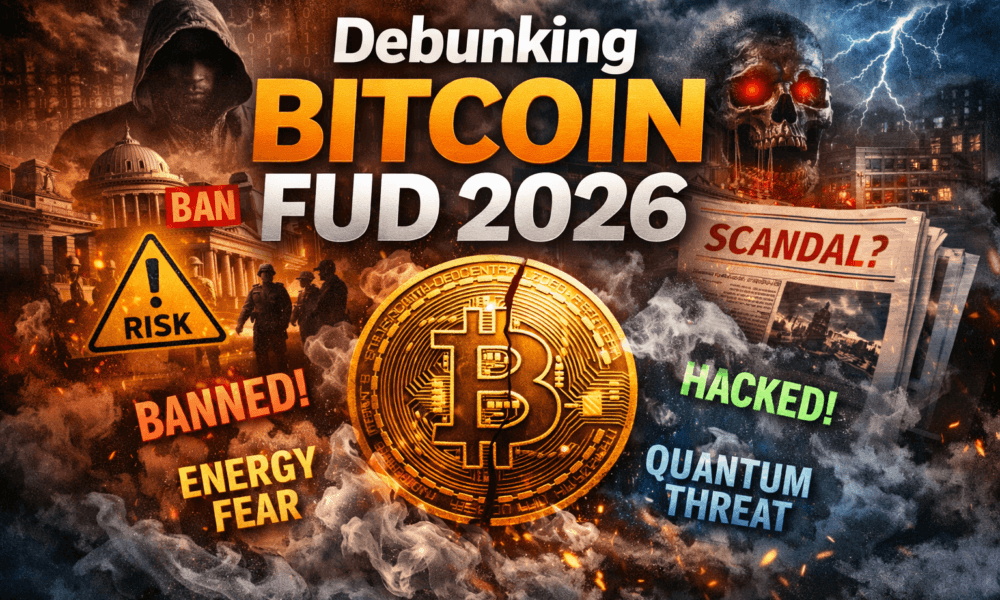
Bitcoin has been declared “dead” hundreds of times over the past decade and a half. Yet here it is! still running, still growing, and still being adopted around the world.
If you’ve spent any time in the market, you’ve likely noticed a pattern: every time Bitcoin dips, the same fears, uncertainties, and doubts (better known as FUD) resurface.
This article breaks down what FUD actually means and addresses some of the most common narratives that continue to circulate in 2026.
Table Of Content
- What Is FUD?
- “Bitcoin Is an Empty Asset”
- “Bitcoin Mining Uses Too Much Energy”
- “Bitcoin Will Be Banned”
- “Quantum Computing Will Break Bitcoin”
- “Satoshi’s Wallets Will Suddenly Move”
- “What If There’s a Critical Bug?”
- “War Could Kill Bitcoin”
- “New Narratives: Controversies and Associations”
- The Bigger Picture
What Is FUD?
FUD stands for Fear, Uncertainty, and Doubt.
It refers to negative or misleading information, sometimes intentional, sometimes not, that spreads during market downturns and influences investor sentiment.
In Bitcoin, FUD often follows a familiar cycle:
- Price drops
- Negative headlines appear
- Old criticisms resurface
- New investors panic
Understanding FUD is essential because it helps separate short-term narratives from long-term fundamentals.
“Bitcoin Is an Empty Asset”
One of the oldest criticisms is that Bitcoin has “no intrinsic value” or is an “empty asset.”
This argument assumes that value must come from physical backing or cash flows. However, Bitcoin’s value comes from different properties:
- Scarcity (fixed supply of 21 million coins)
- Decentralization
- Censorship resistance
- Global accessibility
In that sense, Bitcoin functions more like sound money, similar to gold, but in digital form.
Millions of people trust Bitcoin not because it produces cash flow, but because it offers:
- a hedge against monetary inflation
- financial sovereignty
- a system that does not rely on centralized control
“Bitcoin Mining Uses Too Much Energy”
Energy consumption remains one of the most common criticisms.
It’s true that Bitcoin mining uses a significant amount of energy. But this statement alone lacks context.
Key points often overlooked:
- A growing share of mining uses renewable or stranded energy
- Bitcoin mining can stabilize energy grids by absorbing excess supply
- Energy usage is what secures the network
The question is not simply “how much energy,” but what that energy is used for. Bitcoin converts energy into a secure, global, and decentralized financial system.
“Bitcoin Will Be Banned”
Another recurring claim is that governments will ban Bitcoin.
Over the years, multiple countries have attempted restrictions. However:
- Bitcoin is decentralized and operates globally
- Bans often lead to peer-to-peer usage, not disappearance
- Some countries move from banning to regulating or adopting
History shows that while local restrictions can impact usage temporarily, they have not stopped Bitcoin’s global growth.
Another problem with banning a technology like Bitcoin -> it causes you to fall behind the rest of the world.
“Quantum Computing Will Break Bitcoin”
Quantum computing is often cited as a future threat to Bitcoin’s cryptography.
While it’s a valid area of research, there are important considerations:
- Practical quantum computers capable of breaking Bitcoin encryption do not currently exist
- The Bitcoin protocol can be upgraded
- Cryptography evolves alongside technological advancements
This is not an immediate threat, but rather a long-term scenario that the network can adapt to. The fact that we (the community) are already thinking about upcoming scenario’s is a very good thing and makes Bitcoin even stronger.
“Satoshi’s Wallets Will Suddenly Move”
The idea that Bitcoin’s creator could suddenly move large amounts of early coins often creates fear in the market.
However:
- These coins have remained untouched for over a decade
- Even if moved, markets have absorbed large sell-offs before
- Ownership concentration has decreased significantly over time
- After more than 17 years being untouched it is very unlikely that they will ever move
Although it is a big mystery why ~1M BTC from the early days have never been touched, it also adds something unpredictable to the market. This may sound weird, but every market needs a certain risk.
“What If There’s a Critical Bug?”
Another concern is the possibility of a serious flaw in Bitcoin’s code.
While no software is immune to bugs, Bitcoin has:
- been running for over 16 years, 24/7 without downtime
- a global network of developers reviewing code
- a conservative approach to updates
In the past, rare vulnerabilities have been discovered and fixed quickly. The open-source nature of Bitcoin allows continuous review and improvement.
“War Could Kill Bitcoin”
Geopolitical instability often triggers fears about Bitcoin’s survival.
In reality, Bitcoin was designed to operate in uncertain environments:
- It runs on a distributed global network
- It does not rely on a single country or institution
- It can function anywhere with internet access
In some cases, conflict and economic instability have actually increased interest in Bitcoin as an alternative system.
Read our article: The Power of an ‘Empty Asset’ in War Time for more indepth information.
“New Narratives: Controversies and Associations”
More recently, new forms of FUD have emerged, often linking Bitcoin to controversial figures or events.
These narratives attempt to influence perception rather than address the technology itself.
It’s important to distinguish between:
- the protocol (neutral technology)
- individuals or stories associated with it
Bitcoin operates independently of any single person or narrative.
The Bigger Picture
FUD is not new. It has been part of Bitcoin’s story since the beginning. What has changed over time is Bitcoin’s ability to withstand it.
Each cycle of fear has been followed by:
- recovery
- increased adoption
- stronger infrastructure
For long-term participants, FUD becomes easier to recognize. Not as a signal of failure, but as a recurring feature of emerging technologies.

René
Editor