

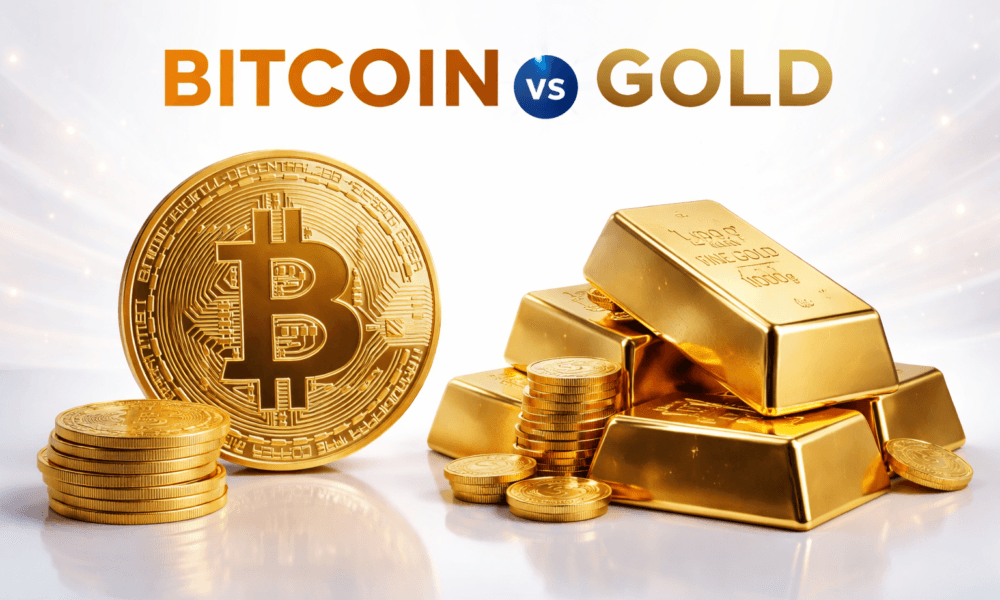
Bitcoin and gold are often compared because they both serve as alternatives to traditional money, especially in times of economic uncertainty. But beneath that shared role, they’re fundamentally different in how they work, how they’re valued, and how people use them.
Table Of Content
The Basics
Bitcoin is a purely digital asset created in 2009. It operates on a decentralized network using blockchain technology, meaning no central authority (like a government or bank) controls it.
Gold, on the other hand, has been used as a store of value for thousands of years. It’s a physical metal, valued for its rarity, durability, and historical role in monetary systems.
Scarcity and Supply
One of the biggest reasons both assets are compared is scarcity.
Bitcoin has a fixed supply: only 21 million coins will ever exist. This is hard-coded into its protocol, making it predictable and resistant to inflation caused by overproduction.
Gold is also scarce, but its supply isn’t fixed. New gold can still be mined, though it becomes increasingly difficult and expensive over time. That said, the total above-ground gold supply grows slowly, typically around 1–2% per year.
Portability and Accessibility
Bitcoin is extremely portable. You can send millions of euros worth of Bitcoin across the world in minutes with just an internet connection and a digital wallet.
Gold is far less convenient. Transporting it is costly, slow, and often requires secure storage and insurance. However, gold has one advantage: it doesn’t require technology to access. In a situation without electricity or internet, gold still functions.
Volatility and Stability
Gold has historically been relatively stable. While its price fluctuates, it tends to move gradually and is widely considered a “safe haven” during economic downturns.
Bitcoin is much more volatile. Its price can swing dramatically within days or even hours. This volatility attracts traders but makes it less predictable as a stable store of value, at least for now.
Regulation and Trust
Gold is universally recognized and regulated. It’s accepted globally, and its value doesn’t depend on a specific technological system.
Bitcoin relies on trust in its underlying technology and network. While it’s decentralized, governments can still regulate how it’s used (for example, through exchanges). Adoption and legal treatment vary significantly between countries.
Use Cases
Gold is widely used in jewelry, electronics, and as a reserve asset held by central banks.
Bitcoin’s main use cases are digital payments, investment/speculation, and as a hedge against inflation, particularly appealing to those who prefer decentralized financial systems.
Environmental Impact
Gold mining has a significant environmental footprint, involving land disruption, water use, and chemical processing.
Bitcoin mining also consumes large amounts of energy, especially due to its proof-of-work system. However, there’s ongoing debate about how much of that energy comes from renewable sources.
Comparison Table
| Feature | Bitcoin | Gold |
|---|---|---|
| Nature | Digital asset | Physical metal |
| Supply Limit | Fixed (21 million) | Limited but not fixed |
| History | Since 2009 | Thousands of years |
| Portability | Very high | Low |
| Divisibility | Highly divisible (up to 8 decimals) | Limited (requires melting/refining) |
| Volatility | High | Low to moderate |
| Regulation | Varies by country | Globally recognized |
| Storage | Digital wallets | Physical vaults/storage |
| Main Use | Investment, payments | Jewelry, reserves, investment |
| Environmental Impact | High energy use | Mining-related environmental damage |

René
Editor